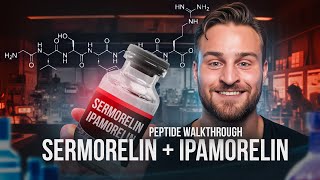
What is Ipamorelin?
Ipamorelin is a short peptide that binds the ghrelin and growth hormone secretagogue receptor. It is one of the most selective growth hormone secretagogues known, shown in laboratory studies to have little or no effect on ACTH, cortisol, prolactin or other pituitary hormones.
That selectivity is its main appeal. It prompts growth hormone release without the larger rises in hunger, cortisol and prolactin seen with stronger peptides in the same family.
How does Ipamorelin work?
Like other peptides in its class, Ipamorelin binds receptors in the pituitary that trigger the release of growth hormone into the bloodstream, which then supports IGF-1 and, in turn, muscle and recovery.
It is often combined with a growth hormone releasing hormone such as CJC-1295 or MOD-GRF 1-29. The GHRH and the secretagogue act on different parts of the signal, so together they can produce a larger growth hormone release than either alone.
Mixing it for research?
Ipamorelin reconstitution chart: how much bacteriostatic water to add to a 5 mg vial and how many units each amount is, with Matthew’s step-by-step video.
See the mixing chartWhat has research looked at?
- Growth hormone
- Its core action, a clean, selective release of growth hormone.
- Selectivity
- Studied for leaving cortisol and prolactin largely untouched, unlike stronger peptides.
- Pairing with a GHRH
- Commonly combined with CJC-1295 or MOD-GRF for a stronger effect.
- Muscle and recovery
- Interest in muscle and recovery through IGF-1, mostly from non-clinical settings.
Ipamorelin is well characterized as a selective growth hormone secretagogue. Its use for muscle and body composition is far less formally studied than its basic pharmacology.
What research has looked at, area by area
Each area is marked with the kind of study behind it: in people, in animals, or in cells in a lab.
- Human studiesGrowth hormone release in people. In healthy male volunteers given it into a vein at five dose levels, blood levels rose in step with the dose, the terminal half-life was about 2 hours, and growth hormone peaked at roughly 40 minutes. The studies measured hormone levels, not outcomes.1
- Animal studiesSelectivity, and where that claim comes from. In rats and pigs it released growth hormone about as strongly as the older peptide GHRP-6 but, unlike it, did not raise the stress hormones ACTH and cortisol, even far above the dose needed for growth hormone. This is the basis of its reputation for being selective, and it rests on animal work rather than human trials.3
- Human studiesThe one controlled human trial. A randomized, placebo-controlled trial in 117 adults after bowel surgery tested it for slow gut recovery. People given it tolerated a solid meal a median 25.3 hours after the first dose against 32.6 hours on placebo, which was not a statistically significant difference, and the authors reported no significant differences in the other efficacy measures either.2
- Animal studiesBone in rats. Two rat papers looked at bone. In adult female rats, 15 days of injections raised the rate of long-bone growth a little, in step with the dose, and increased weight gain. In another study in adult female rats on steroid treatment, adding it offset the steroid's drop in bone formation and muscle strength over 3 months. Both are animal studies, and nothing comparable has been done in people.4,5
Ipamorelin dosage
In research protocols, Ipamorelin is used much like others in its class, around 100 to 300 mcg per injection, often several times a day and frequently paired with a GHRH, in cycles of 8 to 12 weeks on and 4 to 8 weeks off, around meal timing.
| Amount | How often | Cycle | Timing | Source |
|---|---|---|---|---|
| 100 to 300 mcg | Up to several times a day, often with a GHRH | 8 to 12 weeks on, 4 to 8 weeks off | About 30 minutes before eating, or 2 hours after | Common research protocol |
Research protocols for education, not medical advice.
Cautions: It may cause water retention, headaches or blood-sugar changes, generally milder than stronger secretagogues, and caution is advised for existing hormonal conditions. More under side effects and cautions.
Ipamorelin is most often used together with a growth hormone releasing hormone such as CJC-1295 or MOD-GRF. Carbohydrates and fats can blunt the growth hormone response, which is the reason for the meal timing.
Side effects and cautions
Because it raises growth hormone, Ipamorelin can have hormone-related effects, though it is considered gentler than stronger peptides in its class. Anyone with health questions should talk to a qualified clinician.
- Common effects
- It may cause water retention, headaches or changes in blood sugar, generally milder than stronger secretagogues.
- Hormone conditions
- Caution is advised for anyone with existing hormonal imbalances or conditions.
- Product content
- Material sold outside medical settings can differ from its label.
Safety, checked against the sources
Side effects reported
- Human studiesIn the one controlled human trial, side effects were common in both groups and slightly more frequent on placebo, and the authors reported it was well tolerated. It was a seven-day trial in people recovering from surgery, so it says little about longer use in healthy people.2
- Animal studiesIn rats and pigs it did not raise the stress hormones ACTH and cortisol, which separates it from the older peptides in its family. This has not been shown in people.3
For education and research only. Not medical advice.
References
The studies and records behind the checked facts on this page, each with one line on what it found.
- Gobburu JV, Agersø H, Jusko WJ, Ynddal L Pharmaceutical Research, 1999. Healthy men, eight at each of five dose levels, infused into a vein over 15 minutes: dose-proportional kinetics, terminal half-life 2 hours, clearance 0.078 L/h/kg, growth hormone peaking at 0.67 hours; variation between people was larger for the hormone response than for the kinetics. Abstract re-read via Europe PMC in pass 2. PubMed ↗
- Beck DE, Sweeney WB, McCarter MD; Ipamorelin 201 Study Group International Journal of Colorectal Disease, 2014. Multicentre, double-blind, placebo-controlled proof-of-concept trial: 117 adults enrolled after bowel resection, 114 analysed, ipamorelin or placebo into a vein twice a day for up to seven days. Median time to a tolerated solid meal 25.3 h vs 32.6 h (p=0.15); no significant differences in key or secondary efficacy analyses; treatment-emergent adverse events 87.5% vs 94.8%; well tolerated. Abstract re-read via Europe PMC in pass 2. PubMed ↗
- Raun K, Hansen BS, Johansen NL, Thøgersen H, Madsen K, Ankersen M, Andersen PH European Journal of Endocrinology, 1998. Rats and pigs (plus rat pituitary cells): the pentapeptide Aib-His-D-2-Nal-D-Phe-Lys-NH2 released growth hormone with potency similar to GHRP-6; in pigs, unlike GHRP-6 and GHRP-2, it did not raise ACTH or cortisol even at doses more than 200 times its growth hormone ED50. Authors: selectivity similar to GHRH. Abstract read on academic.oup.com in pass 2. PubMed ↗
- Johansen PB, Nowak J, Skjaerbaek C, Flyvbjerg A, Andreassen TT, Wilken M, Orskov H Growth Hormone and IGF Research, 1999. Adult female rats, injections three times daily for 15 days at four dose levels: longitudinal bone growth rose from 42 to 44, 50 and 52 micrometres a day (P<0.0001), dose-dependent; pronounced dose-dependent weight gain; total IGF-I, IGFBPs and bone turnover markers unchanged. Abstract read via Europe PMC in pass 2. PubMed ↗
- Andersen NB, Malmlöf K, Johansen PB, Andreassen TT, Ørtoft G, Oxlund H Growth Hormone and IGF Research, 2001. Eight-month-old female rats, 3 months of injections: with methylprednisolone, adding ipamorelin increased periosteal bone formation rate four-fold against steroid alone and counteracted the steroid-related fall in muscle strength. Abstract read via Europe PMC in pass 2. PubMed ↗
Further reading
This page summarizes the research in plain words. To read the studies yourself:
- Published studies on Ipamorelin PubMed, US National Library of Medicine
- Ipamorelin reconstitution chart water and units for each vial size