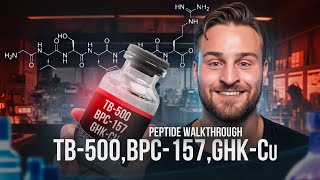
What is in each blend
Because both names are informal, the forms and amounts of each part can differ between sources. That is especially true for TB-500, where labels may not say whether it is the short fragment or the full protein. None of the four parts is an approved medicine, and each was developed and studied separately by different research groups.
- BPC-157
- A 15-amino-acid synthetic peptide based on a protein reported in human gastric juice. Rat studies looked at tendons, ligaments, muscle and gut lining; human data are a few small, uncontrolled reports.
- TB-500
- A synthetic peptide modeled on thymosin beta-4, usually a short actin-binding fragment. Small human trials used the full protein for skin ulcers and eye conditions, with mixed results; the fragment has very little research.
- GHK-Cu
- A three-amino-acid peptide found in human plasma, bound to copper and common in skin care. Lab and animal studies linked it to collagen and wound repair, and small cosmetic studies of creams reported modest skin improvements.
- KPV (KLOW only)
- Lysine, proline and valine, the last three amino acids of alpha-MSH. Cell studies and mouse models of colitis reported less inflammation; there are no published human trials.
What KPV adds
KPV is the only difference between the two blends. It matches the tail end of alpha-melanocyte-stimulating hormone, a hormone known for its roles in skin pigment and in calming inflammation. In cell studies, KPV lowered activity of NF-kappa B, a protein complex that switches on many inflammatory genes, and reduced inflammatory signals such as TNF-alpha. In intestinal cells it was reported to be carried inside by PepT1, a transporter whose levels rise in inflamed gut tissue.
So the idea behind KLOW is to set an anti-inflammatory piece alongside the repair-focused parts of GLOW. That idea rests on cell work and mouse colitis models, which capture only part of human bowel disease. KPV has not been tested in published human trials, and unlike alpha-MSH it is not generally thought to darken the skin. The KPV profile covers its research.
Neither blend has been studied as a combination
There are no published animal or human studies of GLOW or KLOW. The case for each blend is built from separate research on each part, done by different groups, in different models and over different time frames. Those results cannot simply be added together, and no study has tested whether the parts help or hinder each other, or whether combining them changes safety.
It also means there is no research comparing the two blends. Adding KPV adds a fourth body of early research, not evidence that KLOW does more than GLOW. Only GHK-Cu applied to the skin and full-length thymosin beta-4 have meaningful human trial data, and neither was tested as part of a blend. The skin evidence comes from creams applied to the skin, not from blends.
Side effects and cautions
No safety studies exist for either blend, and each part has limited or no human safety data, apart from GHK-Cu applied to the skin. People often report stinging or burning with blends that contain GHK-Cu, along with redness, nausea, headache or tiredness, but these reports are anecdotal. Anyone with health questions should talk to a qualified clinician.
- Cancer history
- BPC-157, thymosin beta-4 and GHK-Cu have been linked to blood vessel growth in lab or animal studies, a theoretical concern for people with current or past cancer.
- Copper
- Both blends contain GHK-Cu, which adds copper, an extra unknown for people with conditions affecting copper handling, such as Wilson disease.
- KPV and immunity
- KLOW's KPV is studied for dampening inflammatory signals, and how that affects fighting infection in people is unknown.
- More parts, more unknowns
- Each added compound is another way for effects and side effects to overlap, and premixed blends may not match their labels.
- Pregnancy and breastfeeding
- There are no safety data for any of the four parts.
- Dosage
- The GLOW profile and the KLOW profile each have a dosage section.