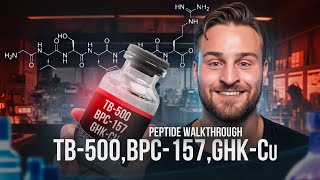
What is BPC-157 + TB-500?
BPC-157 is a 15-amino-acid synthetic peptide based on part of a protein reported in human gastric juice. Most of its research comes from rat studies of tendon, muscle and gut injury. TB-500 is a synthetic peptide modeled on thymosin beta-4, a protein found in nearly every cell. It usually means a short fragment containing the part of thymosin beta-4 that binds actin.
The two are sometimes sold premixed as one product and sometimes discussed as a pair. Online, the combination is often nicknamed the wolverine stack. That name is marketing, not science. Neither peptide is an approved medicine, and they were developed and studied separately.
How does BPC-157 + TB-500 work?
The idea behind the pairing is that the two peptides seem to work through different mechanisms. In animal and cell studies, BPC-157 has been linked to new blood vessel growth through the VEGF pathway, effects on the nitric oxide system and more growth hormone receptors on tendon cells. Thymosin beta-4, the protein TB-500 is based on, binds actin and has been linked to cell migration toward injured tissue, blood vessel growth and lower levels of some inflammatory signals.
Since these routes differ, some people reason the effects might add up. That is a hypothesis. No published study has tested whether the two together do more than either alone, or whether combining them changes safety. The animal studies behind each peptide also used different models and time frames, so their results cannot simply be added together.
Mixing it for research?
BPC-157 + TB-500 reconstitution chart: how much bacteriostatic water to add to a 10 mg (5/5) or 20 mg (10/10) vial and how many units each amount is, with Matthew’s step-by-step video.
See the mixing chartWhat has research looked at?
- BPC-157 and tendons
- In rat studies, researchers reported better healing of damaged Achilles tendons, ligaments and muscle. Most of this work comes from one research group in Croatia.
- BPC-157 and the gut
- Rat studies looked at stomach ulcers and bowel damage, and an early clinical program for bowel disease was reported, but detailed human results are hard to find.
- Thymosin beta-4 and wounds
- Animal studies reported faster wound closure, and small human trials of a thymosin beta-4 gel tested it on chronic skin ulcers, with limited and mixed results.
- Thymosin beta-4 and heart or eye
- Mouse studies of heart attack reported better heart cell survival. Human trials of thymosin beta-4 eye drops for dry eye and corneal healing had mixed results.
- TB-500 itself
- The short TB-500 fragment has very little research of its own. Most claims about it are borrowed from studies of full-length thymosin beta-4.
- The combination
- There are no published animal or human studies of BPC-157 and TB-500 given together.
So the case for this blend rests on two separate sets of mostly animal research. That is a reason to treat claims about the pair with caution, not a sign the combination has been shown to work. Even the human trials that exist for thymosin beta-4 used the full protein, a different molecule from the short TB-500 fragment usually sold.
Why BPC-157 and TB-500 are paired
Interest in the pairing comes from overlap in what each peptide has been studied for, mainly soft tissue and wound repair, plus the fact that they appear to act at different points in the healing process. One is linked to blood vessel signaling and the other to how cells move and organize. That reasoning is plausible, but plausibility is not evidence. Until the combination is studied, its effects, benefits and risks in people remain unknown.
Side effects and cautions
Neither peptide has large human safety studies, and the combination has none. Small human trials of full-length thymosin beta-4 reported it was generally well tolerated, and animal safety studies of BPC-157 reported few toxic effects. Effects people describe online, such as irritation where it was injected, headache, tiredness or water retention, are anecdotal. Anyone with health questions should talk to a qualified clinician.
- Cancer history
- Both peptides have been linked to blood vessel growth, and thymosin beta-4 to tumor spread in some lab studies. That is a theoretical concern for people with current or past cancer.
- Unknown interactions
- Combining two compounds can change effects in ways that single-compound studies do not show.
- Product content
- Premixed blends may not match their labels in amount or purity, and TB-500 labels may not say which form is inside.
- Pregnancy and breastfeeding
- There are no safety data for either peptide.
Further reading
This page summarizes the research in plain words. To read the studies yourself:
- Published studies on BPC-157 PubMed, US National Library of Medicine
- Published studies on thymosin beta-4, the protein TB-500 comes from PubMed, US National Library of Medicine
- BPC-157 + TB-500 reconstitution chart water and units for each vial size